
Haymarket Police Department Achieves VLEPSC Accreditation
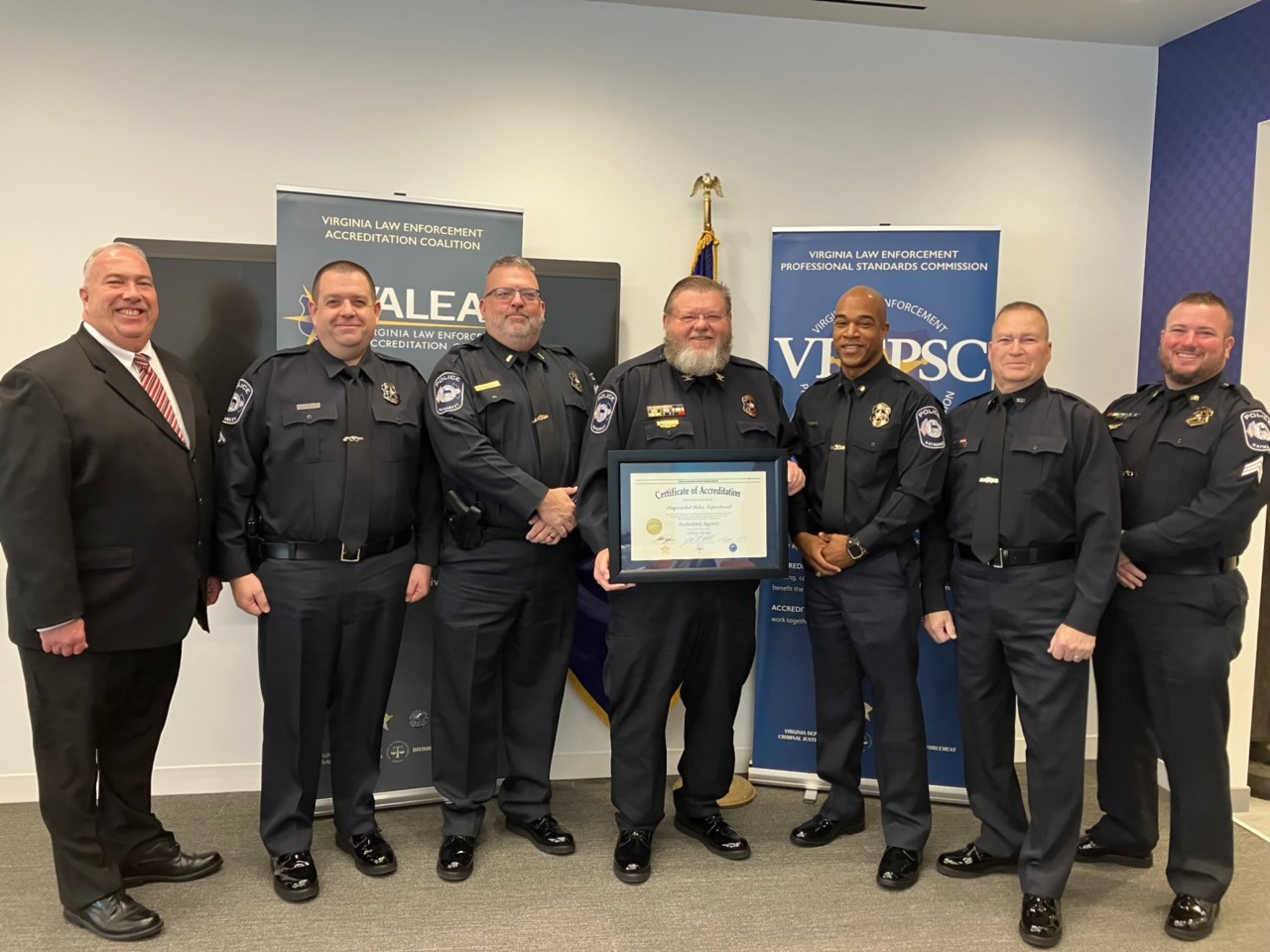
On December 4, 2025, Haymarket Police Chief Allen Sibert and members of his staff met with the review board in Charlottesville and became the 115th department in Virginia to receive agency accreditation from the Virginia Law Enforcement Professional Standards Commission, VLEPSC. Some benefits of being accredited are access to different grants, aiding in liability defense, improving operations through peer review, ensuring officer safety, increasing morale, reduction in liability insurance cost, and facilitating better community relations by aligning goals with citizen expectations, ultimately enhancing crime prevention and service.
Haymarket Police Department's achievement is the result of three years of dedicated work towards meeting the accreditation standards.
Prince William County Sheriff’s Office was the first Sheriff’s Office in the Commonwealth of Virginia to become accredited, (1996) and received their 8th recertification on the same day that Haymarket received their initial. There are more than 340 Law Enforcement agencies in Virginia.
Chief Sibert said, “becoming accredited is a monumental achievement that speaks to the dedication and professionalism of our staff. There are many advantages to being an accredited agency, most importantly, the professional image it projects of our department, our staff, and our community.
What is accreditation and what is the benefit of achieving an accredited status?
Accreditation increases the law enforcement agency’s ability to prevent and control crime through more effective and efficient delivery of law enforcement services to the community it serves. Accreditation enhances community understanding of the law enforcement agency and its role in the community as well as its goals and objectives. Citizen confidence in the policies and practices of the agency is increased. Accreditation, in conjunction with the philosophy of community policing, commits the agency to a broad range of programs (such as crime prevention) that directly benefit the public. Accreditation creates a forum in which police and citizens work together to control and prevent crime. This partnership will help citizens understand the challenges that confront law enforcement. Law enforcement will, in turn, receive clear direction from the community about its expectations.
The governing body, (The Virginia Law Enforcement Professional Standards Commission, VLEPSC) was established to provide law enforcement agencies in the Commonwealth with an avenue for demonstrating that they meet commonly accepted professional standards for efficient and effective agency operation. The mission of the Virginia Law Enforcement Professional Standards Commission is to advance law enforcement professionalism through the establishment of professional standards and the administration of a formal mechanism by which Virginia agencies can be systematically measured, evaluated, and updated. The Commission goals include:
- To increase the effectiveness and efficiency of law enforcement agencies in the Commonwealth of Virginia in the delivery of services.
- To promote cooperation and coordination among all components in the criminal justice system.
- To ensure the appropriate level of training for law enforcement personnel.
- To promote public confidence in law enforcement; and
- To promote the professionalism of law enforcement agencies in the Commonwealth of Virginia.
For a department to achieve accreditation, the process begins with an application to the program and a “self-assessment” phase. During the self-assessment phase, the department reviews and updates its polices, assures procedures are being followed and tracked, and implements documentation that can be used as proofs of compliance. This part of the process lasts from 24-36 months.
The next step is the on-site assessment. During this step in the process, a team of assessors assigned by the VLEPSC director inspects polices, folders, proofs of compliance, while simultaneously interviewing officers about procedures, inspecting equipment, and evaluating the day-to-day practices of the office. This step takes 3 days, and the assessors review 193 folders containing 654 bullet points that must be met.
The last step is for the Chief of Police to present himself before a Board of Review. At the review board, a report on the assessors’ findings is presented by the chief assessor. Board members may then ask the Chief questions about the findings. If all standards have been met and the review board is satisfied with the findings, the board then votes rather or not to accredit the agency.